

Adhyakrativeer Umaji Naik
Most of us grew up learning that the first fight for India’s freedom began in 1857. Schoolbooks call it the “first war of independence.” But the truth is not this, it is deeper. The fire of rebellion was lit much earlier by a man named Adhyakrantiveer Umaji Naik, who rose against the British in the early 1800s, when their empire was still taking root. His struggle lasted over a decade, and though history has buried his name, his spirit remains alive in the soil of Maharashtra.
Umaji Naik was born on 7th September 1791 in Bhiwadi, a small village near the Purandar fort. He belonged to the Ramoshi community, a clan of warriors, watchmen, and scouts who had served kings and kingdoms for centuries. They were tough people, assigned the role guarding forts, farming fields, and lived with courage.
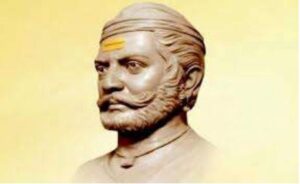
His parents, Laxmibai and Dadaji Khomane, raised him in a tradition of discipline and honour. The family carried the title “Naik” meaning leader because for generations they had defended Purandar fort. From childhood, Umaji was trained in the arts of war. His father taught him how to wield a sword, shoot arrows, and ride with agility. By the time he grew up, he was tall, broad-shouldered, and sharpminded like an ideal warrior.
But the land around him was changing. The Maratha power had declined, Pune had fallen, and the British were tightening their grip. Britisher stripped old clans like the Ramoshis of their responsibilities, and filled positions of power with their loyal servants. Taxes rose adversely, injustice spread, and ordinary villagers felt abandoned.
Umaji could not bear to see his people crushed. Like many in Maharashtra, he had grown up listening to the accounts of Chhatrapati Shivaji Maharaj. For him, Shivaji Maharaj was not just history but an ideal reminder that foreigners could never truly own this land.
One day, in the temple of Lord Khandoba at Jejuri, Umaji and his close companions Vithuji Naik, Krushna Naik, and Bapu Solaskar took an oath that they would fight until their last breath to drive the British out of undivided India. This moment was the birth of Umaji’s revolution.
Umaji began a daring campaign. He robbed government treasuries and the wealthy who supported the British, only to give the money back to the poor. His men fed hungry families, repaired temples, and stood up for women who suffered at the hands of oppressors. In villages, his name became a promise of justice.
This Robin Hood-like figure terrified the British. They arrested him once, locking him away for a year. But prison only made him stronger, he learned to read and write, and when he came out, his rebellion grew remarkably. More young men joined his ranks, and soon the hills and forests of Maharashtra echoed with his guerrilla attacks on British forces.
The British sent Captain Alexander Mackintosh to crush Umaji. However, time and again, Umaji escaped, ambushed, or outright defeated the British forces. Once, he killed five soldiers in battle and sent their severed heads back to the British camp, this was a chilling reminder that India would not be ruled by invaders.
In 1824, he raided the treasury at Bhamburda near Pune, distributing the loot among villagers. By 1827, he declared that sparks of revolution would rise from Satpuda to Sahyadri mountains. In 1830, near Mandharadevi hill, he defeated another British unit led by Officer Boyd, using simple slings and muskets to scatter trained soldiers. Umaji was more than just a bandit-warrior. He was a visionary. On 18th February 1831, he gave a call that shook the foundations of the British Raj: stop paying taxes, quit government jobs, loot British treasuries, and paralyse their rule. This was not rebellion but a revolution. He demanded Swaraj, self-rule, decades before 1857.
The British knew Umaji was dangerous not only because of his raids but also due to his ideas. He had shown the people that the British empire could be resisted. To stop him, they announced bounties worth thousands of rupees. Soon betrayal came. A man named Kaloji Naik, once punished by Umaji for insulting a woman, turned out to be an informer. Others, lured by British rewards of money and land, began to leak information. Umaji’s movements were tracked, his men were arrested, and slowly the circle closed in.
On 15th December 1831, in Utroli village near Pune, Umaji was finally captured by Captain Mackintosh. Despite being inhumanely tortured for days, he refused to reveal anything. Hereafter judge James Tailor sentenced him death penalty. On 3rd February 1832, at the age of just 41, Umaji Naik was hanged till death in Pune. His body was left hanging for three days, as a warning to the people.
Even his enemies recognised his greatness. A British officer named Robert once wrote: “Umaji’s Ramoshi clan is up in arms against us. They are actively working for an alternate political dispensation. People are supporting their cause. Who knows, he might be another Chhatrapati Shivaji Maharaj.”
Captain Mackintosh too admitted: “Shivaji Maharaj was Umaji Naik’s idol. If he was not hanged, he would have become another Shivaji.”
Umaji Naik’s fight shows us that India’s desire for freedom did not begin in 1857. It was already alive in the hearts of men like him decades earlier. His call for Swaraj, and his refusal to bow down to foreign rulers made him the first freedom fighter of British India. And yet, his story is barely remembered. Historians like R.C. Majumdar have pointed out how official history often overlooks such early rebels because they do not fit the neat narrative of “1857 as the beginning.” Scholar Sumit Sarkar too has written about how the colonial state, and later nationalist historians, sometimes simplified history by ignoring scattered but significant struggles. Umaji’s name was one of the victims of this silence.
But memory has its own power. In villages across Maharashtra, the stories of Umaji Naik are still sung, told, and passed down not as history from a book, but as living fire. He remains a symbol of courage, justice, and the undying will of ordinary people to rise against injustice.
We bow our heads to Adhyakrantiveer Umaji Naik, the forerunner of India’s freedom struggle, whose sacrifice lit the first torch of Swaraj.
Chandrashekhar Jadhav ( Chandrashekharj0099@gmail.com)
References:
- Anand, A. (2019, December 20). “Umaji Naik: A forgotten hero”. The Nationalist View. Accessed from the Nationalist View.
- Jadhav, S. S. (15 August 2022). Unrepresented histories are unfair to the sacrifices of those like Umaji Naik. Indie Journal. Accessed from Indie Journal.