

Sree Narayana Guru
Celebrated as the father of modern Kerala, Sree Narayana Guru’s contributions represent a transformative moment in the region’s history, emerging during a period when caste-based hierarchies were deeply entrenched and social mobility for marginalized communities was severely restricted. He was born on August 20, 1856, to Madan Asan and Kuttiyamma in an Ezhava family of Ayurvedic physicians in the village of Chempazhanthy near Thiruvananthapuram, in the former state of Travancore.
At the time, his community was facing extreme social ostracism. This exclusion included denial of entry into temples, lack of access to Sanskrit education, and even the shadow of a lower caste was considered polluting by the upper caste communities therefore, a widespread social ostracism was at its peak. From an early age, he demonstrated a profound sensitivity toward the deep-seated injustices of the caste system.
These experiences led him to critically examine the deeply entrenched caste hierarchies that shaped Indian society. In response to this injustice, Guru envisioned an egalitarian social order based on spiritual and moral upliftment. He dreamed of a society free from the rigid constraints of caste discrimination and untouchability one where education, compassion, and ethical conduct, rather than inherited social status, determined a person’s worth.
Guru Narayana was wise and intelligent ever since he was a child if he learned something once, he wouldn’t forget it forever. He had knowledge of vedas, uppanishads, literature, yoga, etc. he went on to become a saint, spiritual leader, philosopher, and social reformer.
His life’s dedication can be understood through two key areas in which he made significant contributions: one focused on uplifting people from the constraints of the caste system, he once explained his famous quote
“One Caste, One Religion, One God for Mankind”
In a newspaper namely, ‘Kerala Kaumudi’ founded by C.V. Kunhiraman and read by the commoners at that time. He explained that all the religions have one ultimate goal which is same for instance, just like how the streams flow together to form a river; the differences disappear. He continued that the religion should uplift an individual towards the summit and once that is accomplished, every individual will find their way. He further explained, if to bring an end to the religious conflicts, every individual should be taught other people’s religion and they should learn it without any negative notions. while the other aimed at liberating religion from superstition, taboos, and ritualism.
For example, in a village of Kerala, Guru Narayana walked into a place of worship of god Chathan which followed a barbarous rite in name of worshipping, Guru Narayana collectedly told the villagers that such rites as drunk brawl, sacrifice of fowls, etc. should be stopped, the drunk villagers did not disobey Guru Narayana they agreed “we do not have any objection” but still majority of them questioned “but what if we upset the god Chathan?” Guru Narayana decided to call the maistry of Chathan and confront him about the income which went into his pockets from the sale of all these sacrificed fowls. The maistry admitted. Such rites or ceremonies came to an end at that shrine since then.
In the year 1888, Guru’s first bold and historic act was the consecration of a Shiva idol at Aruvippuram. At a time when people from marginalized communities like the Ezhavas were not even allowed to enter temples, Guru’s act of touching and installing a deity was nothing short of revolutionary. This act was not the end of all, he continued building temples all over Kerala, one or two at Karnataka, few in Sri Lanka and Tamil Nadu.
Guru Narayana dreamed of a society free from the rigid constraints of caste discrimination and untouchability one where education, compassion, and ethical conduct, rather than inherited social status, determined a person’s worth.
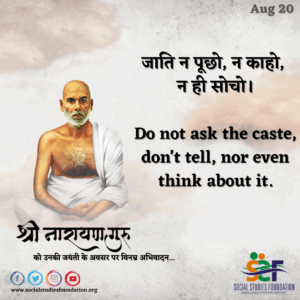
From his point of view an ideal society was where education leads the society to higher standards for the welfare of all around, where everyone are enlightened with education, a society which strengthens through organizations, these organizations shall be based on intellect rather than caste or religion, he advocated for a developed society through industrial progress where people shall do agriculture as it an important sector of Indian economy that contributes to major of GDP and provides employment and many more. In one of his most iconic declarations, “Ask not, say not, think not caste,”
A powerful call to move beyond caste-based barriers and recognize the universality of human life. for instance, Guru Narayana builds a place namely Advaita Ashram at Aluva, in the year 1913. It was and a simple yet engrossing place, consisting a prayer hall where the Hindus, the Muslims and the Christians prayed together according to their own faith. Also, a school and a hostel were there at the ashram without discrimination of caste or religion. All religions literature books were also present at the ashram for students and devotes to read.
Guru did not completely reject religion or caste; instead, he used them as powerful tools to connect with people and guide them toward self-respect and unity. He believed that faith could be a force for upliftment rather than division.
In his universal prayer, Daiva Dasakam, he wrote, “In a land where people live in brotherhood without caste discrimination or religious hatred…”
This prayer is now celebrated as a visionary hymn for collective unity. It reflects the Guru’s radical vision of dismantling caste and religious barriers, aiming to create a just world where equality, dignity, and love for one another are foundational to a stronger society.
At a time when temples, education, and dignity were governed by birth and hierarchy, Guru’s teachings boldly questioned these norms. His rationalist and reformist ideas, though radical and initially met with resistance, laid the foundation for the social awakening that would ultimately contribute to the progress and modernity of Kerala.
His vision was not only expressed through bold actions and reform movements, but also through poetic and philosophical verses that captured his belief in the spiritual oneness of all human beings.
As he beautifully put it:
“One in kind, one in faith,
One in God is man.
Of one same womb, one there is at all.”
For Guru, humanity is one family, our very essence arises from a shared source. We bleed the same, we cry the same, we laugh the same. In the end, it is our shared humanity that binds us. Let it be the force that unites us, not the line that divides us.
-Tanishka Bhosale (tanishkabhosale111@gmail.com)
-Sayali Kamble (ksayali0205@gmail.com)
References:
1. “The renaissance prophet”. Hindustan Times. 13 March 2013.
2. Joseph, Shini & Ajith Kumar, M.P. (2020). Sreenarayana Guru – Teachings, Caste, Religion and God.
3. Srinivasan, R. (2004, August 30). Why Guru matters. Rediff.com
4. “The renaissance prophet”. Hindustan Times. 13 March 2013.
5. “125 years of Aruvipuram Pratishta”. The New Indian Express. 22 August 2013.
6. Social transformations through modern religion a comparatative study of sree Narayan Guru’s and Swami Vivekananda’ s philosophies of religion. (Dinta Muralidharan. 2021.)
7. Sree Guru Narayana. A biography by Murkot Kunhappa
8. Dr. Renjith P. G. 2024. Sree Narayana